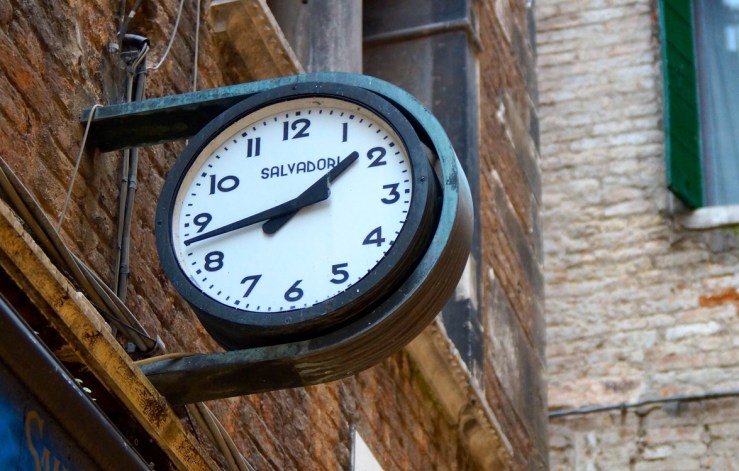
Acts 3:1 – One day Peter and John were going up to the temple at the time of prayer–at three in the afternoon.
When I first heard of praying the hours, I thought it sounded mystical – I assumed it was a spiritual practice associated with monastics or nuns. I was a little surprised to learn that praying the hours, also known as fixed-hour prayer is one of the oldest forms of spiritual disciplines, which roots back to Judaism.
Most people in the modern Protestant church are unfamiliar with the idea of praying the hours – or having a set, disciplined schedule of prayer. Yet praying the hours is a beautiful ancient practice seen in scripture.
King David perfectly understood the idea of praying the hours. In Psalm 119 (the Psalm of renewal) we learn that he prayed seven times a day.
Some might argue that by forcing yourself to pray each day (at appointed times) you are practicing vain religion – but I would counter that prayer at set times – even if it feels devoid of deep, emotional meaning is a way to become spiritually stronger.
Praying when you don’t feel like it isn’t a useless spiritual vanity. On the contrary, this is precisely when we need to pray – when we don’t feel like it.
Millions of people go to a gym each day, even when it’s tough, even when they’d rather stay home, even when their body is tired, and they would rather sleep longer. However, millions wake early for the gym because they understand that if they force themselves to go they will become healthier, slimmer, and stronger – praying the hours has the same effect.
Yeshua woke His disciples as night drew near. He forced them awake to pray. They were tired, exhausted even. However, Yeshua wasn’t going to wait for the disciples to feel motivated. He wasn’t going to wait until ‘inspiration’ struck and the disciples felt compelled to pray – He woke them to pray because the hour was nigh.
These are the last days.
The hour is nigh.
Let’s wake up and pray, even when we don’t want to.
The basement of my friends’ house was filled with art. The art was so incredible, inspirational that I started to cry as I viewed the pieces. I was moved to tears; the art was that beautiful.
And it was in the basement.
The art belonged to her father (at the time she lived with her parents) and he had created lots of work, but then stored it in the basement. I couldn’t believe that he took his amazing work and put it in the basement. I thought it was a sin to put all those beautiful pieces in a dark, unused basement.
Isn’t this what so many people do with their creative talents?
They hide them by putting them in a dark space where no one can see them. I can only think of one instance in the Bible where a man hid a “talent” (in this case the talent was money), and God wasn’t pleased. God isn’t pleased when He blesses us with something of value and we hide it.
When God gives you gifts – those gifts aren’t just for you – they are for you to share.
What if every great intellectual, thinker, writer, entertainer, inventor, and researcher decided that they no longer wanted to share their thoughts, music, gifts, talents, and knowledge with the world?
Can you imagine if all the Adele’s of the world decided to only sing in the shower? What would the world look like? I can’t imagine a world devoid of creative beauty. I don’t want to imagine it.
I believe we are ALL created to contribute in some way. None of us are meant to live in solitary confinement and hide our natural gifts and talents. We are meant to share and build upon the gifts and talents God gives us.
Hoarding your talent is selfish. And selfishness is a sin. Don’t hide your creativity in 2016. If you have a talent, don’t bury it in the ground or place it in darkness. And if you refuse to share your talent, the least that you can do is grow it.
It was around 3 AM, and I knew that unless I opened the door, she would never go away. Her cries were desperate and difficult to drown out. I was tempted to let her in, but my husband gently pulled me back to bed. Her cries echoed like wailing stars outside the block of wood that separated her from us.
I lay there for ten minutes as the intense firestorm at the door increased in pressure. As I leapt towards the door, her body rushed past me. She jumped into the bed with my husband and began to purr. Each day, it was becoming increasingly clear that the cat we rescued suffered from extreme anxiety.
At first, we thought Isabella’s constant desire to be in our presence was endearing. We thought it funny when we’d awake with her perched on top our heads. But then, her fearfulness and anxiety became more pronounced. Each time my husband took a business trip, she gnawed the fur from her body. It was a violent and cathartic way in which our cat dealt with his absence. We knew that the bald patches weren’t the result of allergic reactions or parasites but anxiety.
When the Huffington Post asked people to describe what an anxiety attack feels like, they were flooded with a plethora of responses. Some people said that it feels as if you’re drowning, others described it as feeling as if you are facing a terrorist attack or being chased by dinosaurs. But the consensus is that when a panic attack comes, the walls close in, and a person’s own body becomes their worst enemy. But you can’t escape your body – which is why panic attacks are so tormenting. The attack makes a person want to literally crawl out of their skin. An anxiety attack feels like you are going to die.
Physiologically, when a person experiences a panic attack, the amygdala, which is the fear center of the brain becomes hyperactive. The amygdala is the same region of the brain that kicks into gear when a person senses an imminent threat. Panic attacks cause the region to overreact, and it’s an extreme reaction. The fight-or-flight response is magnified. And then the harrowing experience of panic ensues.
Southern Methodist University conducted a rare study where patients were monitored around-the-clock for physiological instabilities before an attack. The team of researchers discovered that panic attacks are not unexpected. They start about an hour before the patient is fully aware of what’s happening to their body. Although the body is in a panic mode for an hour, it’s only within those last few seconds or minutes that one finally realizes that they feel as if they are going to die. Unfortunately, there is no way to emotionally or mentally survive an hour-long panic attack. Therefore, it is a grace, relief and mercy that the person isn’t aware of what’s happening to them until those last few moments.
The anthesis of anxiety is peace. The book of Philippians, which is called the Book of Peace, also happens to be one of the few places in scripture where the word anxious comes up. In Philippians, the reader is told not to be anxious about anything, but in every situation to pray with a heart of thanksgiving and present requests to God. Prayer is the answer to anxiety.
In the summer of 2014, a study published in Sociology of Religion released its findings on how prayer and anxiety connect, and whether or not the anxious really do find relief. The study acknowledged that prayer helps people manage and reduce negative emotions. The study also noted that how a person envisioned God while they were praying made a difference in their anxiety. Those who benefited the most from prayer were those who saw God as loving and intimate. When people saw God as distant and cold, there were no real, tangible benefits and no ease from the anxiety. The studies’ implications are clear. One’s perception of God interacts with both their spirituality and health.
Philippians 4 is devoid of instructions to think of God as loving and intimate. The book of Philippians is a letter written specifically to the people of the church of Philippi – a group of people who believed God to be both loving and merciful, holy and just.
+
No one really knows where anxiety disorders originate. The general thought is that anxiety is a combination of nature and nurture. It is an amalgamation of anxiety-riddled DNA and a life built upon a fault line that ruptures often. A person who grows up in an environment full of abuse or contention may find that they are increasingly anxious as they age. Eventually, they find themselves on a cream colored couch with a prescription for Xanax in their hands. These are the same people that might experience their first panic attack in their mid-twenties. It’s as if a culmination of the all the stress over the years has finally taken its toll on the body. The body wants out.
In The Concept of Anxiety, Kierkegaard describes anxiety as the dizziness of freedom, but he couldn’t have been further from the truth. Anxiety traps a person within the most uncomfortable, primitive confines of their imagination. When one suffers a panic attack, the mind and body are imprisoned. The innocent party desperately wants to escape. There is no freedom in anxiety.
The apostle Peter echoes the sentiments of Paul in the Book of Philippians. Peter tells the Christians to cast all their anxiety on God because God cares for them. God becomes the place to hold the anxiety, and the path through which to transport the emotional baggage is prayer. In Philippians 4:5, Paul tells the church that the ‘Lord is at hand.’ Upon first glance, one might assume that the apostle was referring to the Second Coming. However, Lead Pastor Sam Storms believes that Paul is speaking about the nearness of Christ in terms of time and space.
And so, we are to be anxious for nothing and remember that the Lord is at hand. Before anxiety comes to lodge, we are to remember that God is with us, beside us. And His Presence is the antithesis of anxiety.